
Lumega Ready for SBTi
Lumega is introducing CO₂ reporting on all product data sheets—one of the first LED suppliers in Europe to do so.
Danish company provides businesses, municipalities, and facility managers with precise climate data straight from the data sheet—ready for SBTi, CSRD, green accounting, and ESG reporting
Copenhagen, May 2026 — Lumega ApS, a specialized Danish supplier of professional LED lighting for offices, schools, and commercial spaces, announced today that the company will soon begin publishing verified CO₂ impact data on all product data sheets in its product range. This initiative makes Lumega one of the first LED suppliers in Europe to systematically and continuously publish precise climate data for each individual product—figures that can be used directly in SBTi reporting, CSRD documentation, green accounting, and CSR reports.
While major global lighting manufacturers continue to rely on general sustainability statements, Lumega is taking a concrete and verifiable step: starting in the summer of 2026, every product data sheet will specify exactly how much CO₂ was emitted during the production and delivery of the product, and exactly how much CO₂ the customer saves by using it.
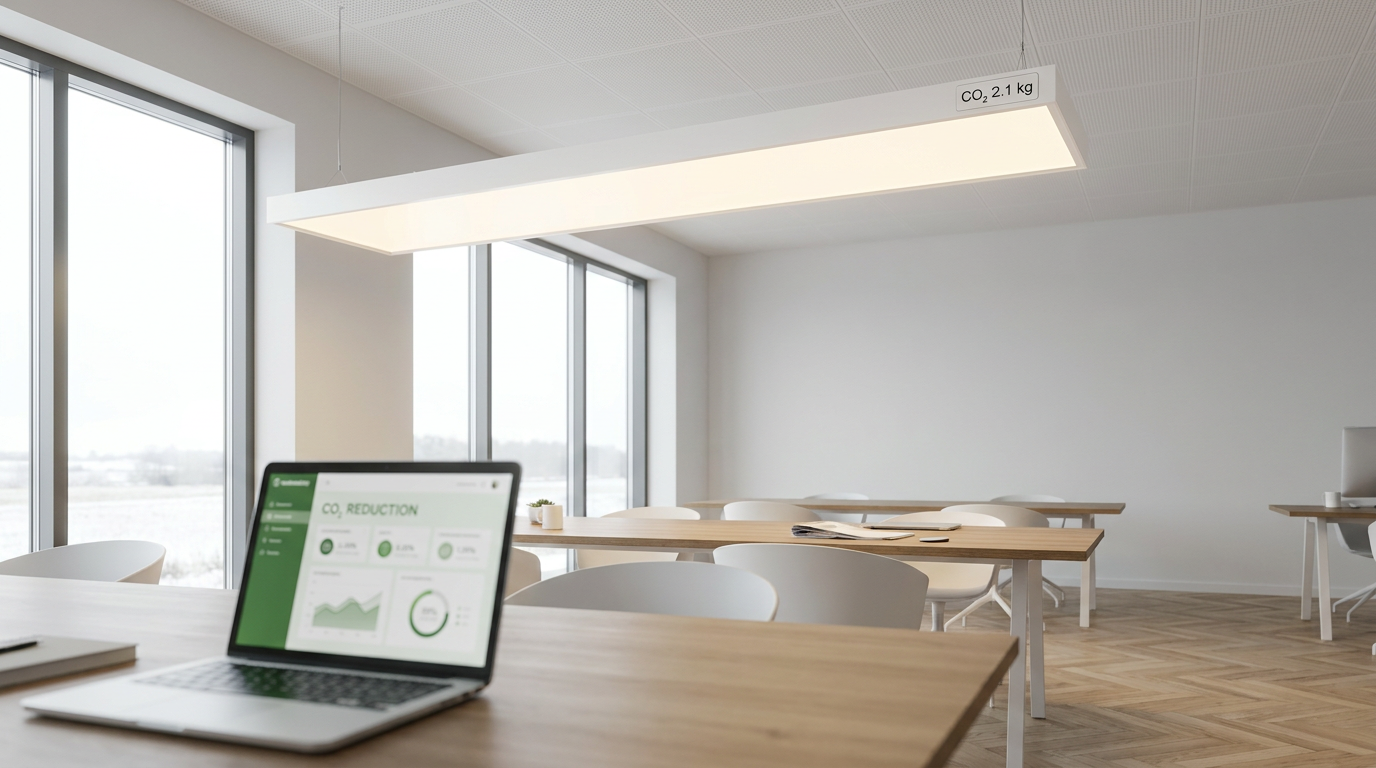
Two figures that are changing the conversation about lighting
Lumega is introducing two key climate-related terms on all product data sheets.
Embodied Carbon is the amount of CO₂ emitted during the product’s lifecycle—from the extraction of raw materials and component production in China, through transport to Denmark, to the finished product on the store shelves. The calculation is detailed and based on the product’s actual physical composition, component by component: LED chips and COB modules, drivers and electronics, lamp housings in cast and extruded aluminum, lenses in PMMA or polycarbonate, wires and connectors, paint and powder coating, mounting accessories, and packaging.
Operational Carbon refers to the CO₂ savings the product delivers over its lifetime compared to the product it replaces. An 18W Lumega LED downlight replacing a conventional 36W fluorescent tube will, at 2,250 operating hours per year—the recognized standard value for educational and office buildings—save approximately 4.9 kg of CO₂ per fixture per year based on the current Danish electricity mix factor from the Danish Energy Agency. Over the product’s 50,000-hour lifespan, this equates to more than 243 kg of CO₂ saved per fixture.
The data sheet will also specify a CO₂ payback period: the number of years it takes before the cumulative operational savings exceed the CO₂ emitted during production and transport. For most Lumega products, this is expected to be less than two years—a figure that reflects exceptionally favorable climate economics and will serve as strong supporting evidence in procurement and bidding situations.
Recycling aluminum yields exceptional CO₂ figures
One of the most interesting aspects of Lumega’s CO₂ documentation concerns the choice of materials—and this is where the company’s products stand out significantly from much of the conventional lighting on the market.
Aluminum is the heaviest component in most LED luminaires and is usually one of the largest contributors to embodied carbon. Primary aluminum production is energy-intensive and typically generates 6–9 kg of CO₂ per kg of metal. Lumega actively uses recycled aluminum in its luminaire housings, and here the picture is fundamentally different: recycled aluminum generates approximately 95% less CO₂ than primary production and can reduce the emission factor to below 0.5 kg of CO₂ per kg.
This means that Lumega’s luminaires made from recycled aluminum will have an embodied carbon footprint that is significantly lower than the industry average—and, combined with a long service life and low power consumption, this results in a CO₂ payback period that, for some products, can be less than one year.
This isn’t marketing. It’s verifiable physics—and it’s exactly the kind of data that green procurement policies, climate leaders, and SBTi advisors are looking for.
Retrofit: The Most Climate-Friendly Solution Is Now Being Quantified
For customers using Lumegas LED retrofit solutions—that is, converting existing fixtures rather than replacing them—the carbon footprint is even more favorable, and Lumegas’s new documentation reveals a data potential that has not previously been available on the market.
With a full retrofit installation, there is no need to manufacture a brand-new luminaire housing. This means that the embodied carbon from the luminaire housing, reflector, and mounting bracket—typically the heaviest part of a luminaire—is not factored in at all. The customer retains the existing infrastructure and replaces only the light source and electronics. The result is a dramatically lower carbon footprint during the production phase, combined with the same or better savings during the usage phase.
As part of the CO₂ documentation project, Lumega will prepare detailed calculations for the retrofit scenario, showing customers not only how much they save in kWh and dollars, but also exactly how much CO₂ they avoid emitting by choosing a retrofit over a complete replacement. For many installations, these calculations will result in some of the most compelling climate data available in the professional lighting sector.
For facility managers who oversee large property portfolios, municipalities renovating public schools and office buildings, or industrial companies upgrading production facilities, this data will provide a robust and immediately actionable foundation for climate reporting—project by project, building by building.
Supply chain down to the component level
The accuracy of CO₂ data depends entirely on the quality of the underlying information. As part of this initiative, Lumega has begun a systematic dialogue with its supply chain—all the way down to the component level.
This involves making direct inquiries to suppliers of LED chips, drivers, aluminum castings, and plastic components regarding actual material compositions, production processes, and any existing climate data. The goal is to replace industry-standardized estimates with real, product-specific data as it becomes available.
This approach is rare in the industry. Most suppliers’ climate data is based on generic material databases and estimated weight distributions. Lumega wants to take it a step further and build a data foundation that can withstand external validation—and, in the long term, serve as the basis for a certified EPD (Environmental Product Declaration) for selected core products.
Engaging the supply chain in this way also directly corresponds to what the SBTi refers to as Scope 3 Category 1—purchased goods and services—and supports Lumega’s customers’ own Scope 3 reduction targets.
What is the SBTi—and why is it relevant to your business?
The Science Based Targets initiative—or SBTi—is a global standard that helps companies set climate targets grounded in science and aligned with the Paris Agreement’s 1.5°C limit on global warming. The initiative is backed by CDP, the UN Global Compact, the World Resources Institute, and WWF. Over 7,000 companies globally have committed to the initiative, and the number is growing rapidly, driven by investor demands, customer demands, and regulation.
The SBTi requires companies to identify and reduce emissions across three scopes.
Scope 1 covers direct emissions from the company’s own operations—heating oil, vehicles, and process gas.
Scope 2 covers indirect emissions from purchased energy—primarily electricity. For most office and manufacturing companies, lighting accounts for a significant and directly measurable portion of Scope 2. Switching from conventional to LED lighting is one of the fastest, cheapest, and most verifiable ways to reduce Scope 2 emissions—and with Lumega’s CO₂ data on the data sheet, the savings can now be calculated precisely.
Scope 3 covers the entire value chain: suppliers’ production, employees’ commuting, and customers’ use of products. Lumega’s contribution here is twofold: first, as a certified Scope 3 Category 1 supplier to its customers, and second, as a company that actively engages its own supply chain to reduce the embedded emissions in its products.
For SMEs—companies with fewer than 250 employees and less than €50 million in revenue—the SBTi offers a simplified approach that requires only Scope 1 and 2 targets. Registration takes about 20 minutes, and targets must typically be met by 2030. With Lumega’s documented lighting data, Scope 2 reduction isn’t just possible—it’s directly measurable.
CSRD and sustainability reporting: from voluntary reporting to legal requirements
In parallel with the SBTi, legislation is becoming significantly stricter. The EU’s Corporate Sustainability Reporting Directive (CSRD) took effect in 2025 and, starting in 2026, will require detailed climate reporting from large and medium-sized companies. The requirements will be gradually expanded to cover an increasing number of companies—including many that are suppliers to larger players already covered by the directive.
This means that the ability to document the climate impact of specific purchases—including lighting—is no longer just a nice-to-have. It is an upcoming compliance requirement.
Municipalities and public institutions are already subject to green procurement policies and climate action plans. Many Danish municipalities have adopted 2030 goals for carbon neutrality and are in the process of renovating older buildings. Lighting is one of the first areas of focus—and access to concrete, product-specific carbon figures from a supplier directly adds value in this context.
With Lumega’s CO₂ documentation included in the product data sheet, a buyer can, for the first time, compare lighting solutions not only based on price and lumens, but also on their documented climate impact—and include this figure directly in the tender documents or the subsequent climate report.
One of the first in Europe — and what that means
It is remarkable how few LED manufacturers and suppliers have, to date, implemented systematic CO₂ documentation at the product level. Even major international brands primarily publish general sustainability reports without product-specific figures. The detailed, verifiable, and continuously updated climate documentation per SKU that Lumega is now implementing is still rare—especially among medium-sized European suppliers.
This gives Lumega a real first-mover advantage in a rapidly evolving market. Companies that are already working with the SBTi and CSRD will actively seek out suppliers who can provide this type of data. Municipalities required to document the CO₂ impact of public investments will prefer suppliers who can provide data rather than promises. And architects and consultants specifying lighting for new buildings will increasingly include climate documentation as a selection criterion.
Lumega is ready.
Special options for retrofit customers
For businesses, municipalities, housing associations, and other organizations that use Lumegas LED retrofit solutions, CO₂ documentation opens the door to a unique form of climate reporting.
Because a retrofit installation is a defined project with known parameters—number of fixtures, wattage before and after, operating hours, building type—it is possible to prepare a precise, project-specific CO₂ report that documents:
Total annual CO₂ savings for the facility in question, in kilograms and tons.
Cumulative CO₂ savings over the expected lifespan of the luminaires.
CO₂ emissions avoided during the production phase as a result of reusing existing fixtures.
CO₂ payback period for the entire project.
Equivalents that make the numbers easier to understand: tons of CO₂ are equivalent to X car trips around the globe, Y trees planted, or Z flights from London to New York.
These reports can be used directly in a company’s CSR report or annual report, a municipality’s climate action plan and carbon footprint calculations, CSRD documentation for indirect emissions, applications for green grants and funding programs, as well as in communications with employees, residents, and other stakeholders.
Lumega will offer project-specific CO₂ documentation to customers undertaking retrofit installations. Contact the company to learn more.
Rollout and availability
CO₂ documentation will be introduced for Lumega’s best-selling products—starting with technical lighting such as downlight series, linear luminaires, panel and box luminaires, as well as track lights and retrofit inserts—during the summer of 2026. The rollout to the entire product range will take place gradually through the end of 2026. Updated data sheets with CO₂ data will be freely available on lumega.eu.
Companies and project planners who wish to access CO₂ data for specific products prior to the full rollout, or who require a project-specific CO₂ calculation in connection with a retrofit installation, are welcome to contact Lumega directly. About Lumega ApS Lumega ApS is a Danish supplier of professional LED lighting specializing in solutions for offices, educational facilities, commercial spaces, and public institutions. The company offers a wide range of luminaires with intelligent control via Casambi and DALI, as well as specialized retrofit solutions for the energy renovation of existing installations. Lumega serves customers in 9 countries and provides consulting on energy optimization, climate documentation, and sustainable lighting. Contact: Rune Søgaard Larsen, CEO rsl@lumega.eu · +45 71 99 58 25 lumega.eu
Keywords
CO₂ data sheet for LED lighting, SBTi Scope 2 lighting, LED CO₂ savings for commercial buildings, Science Based Targets for lighting, energy savings under CSRD, Lumega sustainability, LED retrofit for green accounting, embodied carbon in LED fixtures
CO₂ payback period for LED lighting, green lighting in Denmark, recycled aluminum LED lighting, CO₂ data in the supply chain, CSR lighting for municipalities, green accounting for lighting